Fractures and Orthopedic Injuries: The X-Ray Is Only the Beginning
Zivotov Law | New York City and Long Island
Fractures and Orthopedic Injuries: The X-Ray Is Only the Beginning
A fracture may be diagnosed in one day. Its consequences may take months or years to understand. At Zivotov Law, we follow the recovery, ask what else has changed, and investigate where the medical path may be leading before anyone places a final value on the claim.
What the image shows, and what careful follow-up asks
An X-ray can identify a broken bone. It cannot, by itself, show how the injury may change a person’s movement, work, sleep, independence, emotional health, or future medical needs.
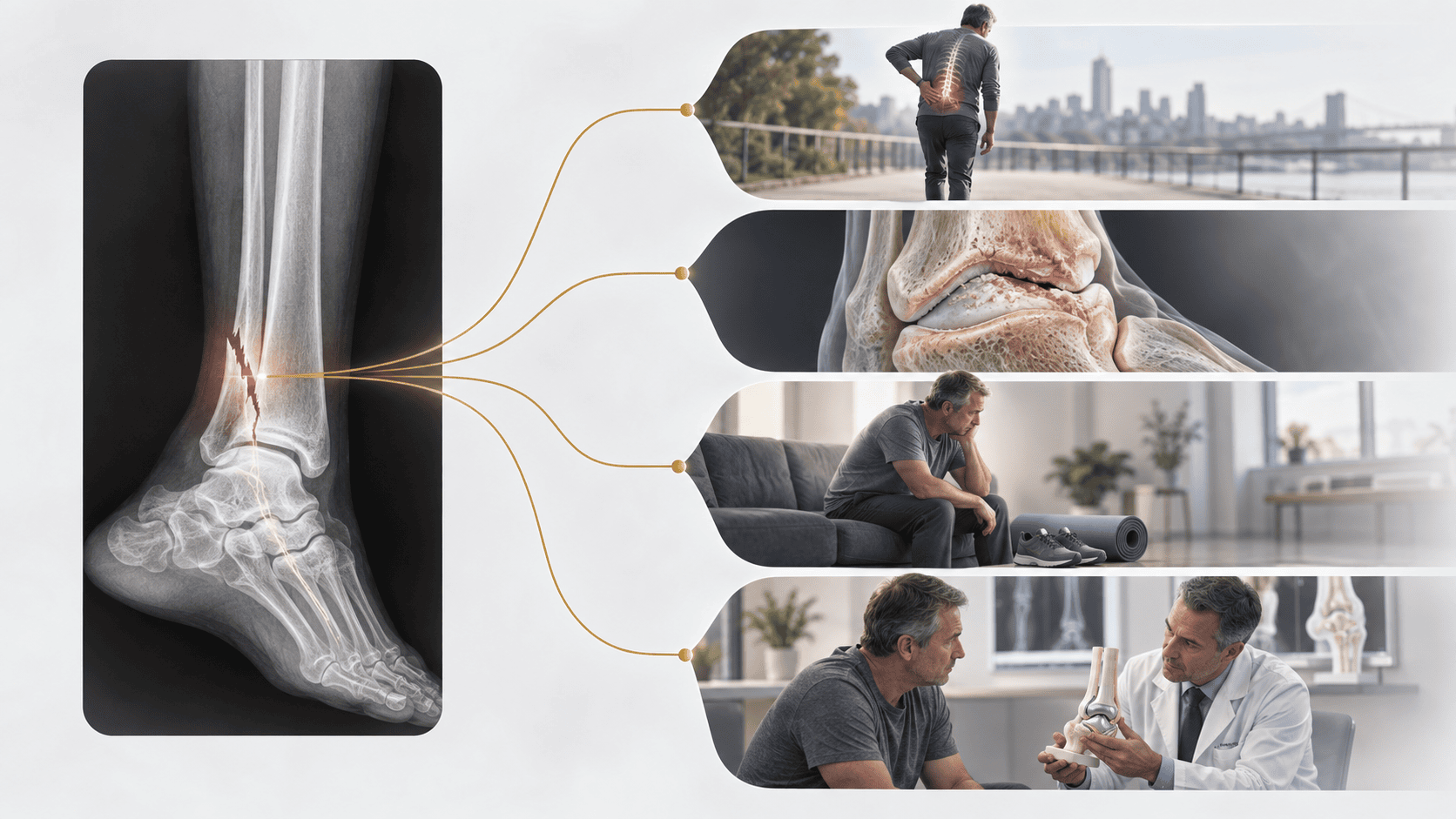
See the whole injury. Build the whole case.
Zivotov Law does not merely process a diagnosis. We follow the medical trajectory, ask the questions that reveal developing problems, and help clients obtain appropriate evaluation before anyone places a final value on the claim.
One injury can begin a much longer medical story
The original orthopedic injury may alter how a person moves and lives. Each later problem must be evaluated on its own medical facts, but the complete sequence should not be ignored.
Initial injury
A fracture, ligament tear, cartilage injury, dislocation, or other trauma changes the structure or stability of a joint or limb.
Treatment and compensation
Immobilization, surgery, weakness, pain, limited motion, or an altered gait may change how the rest of the body carries weight and performs ordinary tasks.
Secondary consequences
Back, hip, opposite-limb, chronic-pain, sleep, emotional, and activity-related problems may emerge during recovery.
Future care
Additional surgery, joint replacement, pain management, rehabilitation, weight management, assistive devices, or other long-term care may become part of the medical path.
Complications are not limited to whether the bone united
Healing, surgery, and hardware
Alignment, joint involvement, soft-tissue damage, nerve or vascular injury, delayed union, nonunion, malunion, infection, scarring, painful hardware, and restricted motion can make two fractures with the same label entirely different injuries.
Altered gait and another body part
A person protecting an injured knee, ankle, hip, or foot may move differently. The medical history should track whether compensatory movement is associated with new back, hip, or opposite-limb symptoms rather than treating each complaint as an unrelated event.
Post-traumatic arthritis and joint replacement
Damage involving a joint can contribute to degeneration, pain, stiffness, and reduced function. The question is not only whether surgery is needed now, but what qualified physicians reasonably anticipate in the future.
CRPS, formerly called RSD
Complex regional pain syndrome may involve severe pain that appears disproportionate to the original injury, extreme sensitivity, swelling, stiffness, reduced movement, or skin-temperature and color changes. It requires medical evaluation; a website cannot diagnose it.
When pain becomes a lasting condition
Pain can persist beyond ordinary tissue healing and become a major clinical problem involving function, sleep, concentration, mood, and participation in daily life. Physicians may use terms such as chronic post-traumatic pain or chronic pain syndrome, depending on the facts. These conditions are not interchangeable with CRPS and require their own medical evaluation.
Psychological adjustment
Loss of mobility, work, independence, recreation, sleep, and confidence can be accompanied by depression, anxiety, trauma symptoms, irritability, or isolation. These are human and medically recognized dimensions of recovery, not signs of weakness.
When injury takes away the ability to exercise
For some people, regular physical activity is what allows them to maintain a stable weight. A serious knee, ankle, hip, or foot injury can remove that ability for a prolonged period.
Reduced activity may be followed by weight gain, greater stress on an already damaged joint, and increased surgical risk. In an appropriate case, medically supervised weight loss or bariatric surgery may become part of preparing for knee, hip, or ankle surgery. That does not happen in every case, and the relationship must be established through the person’s actual history and medical evidence. But the complete treatment sequence should be understood before anyone dismisses a later procedure as unrelated simply because it does not involve the originally fractured bone.
Some warning signs require prompt medical attention
Legal evaluation never replaces appropriate medical care.
Acute compartment syndrome can be an emergency
Sudden severe or rapidly worsening pain, marked tightness or swelling, numbness, weakness, tingling, or difficulty moving after an injury or while in a cast or bandage may require emergency evaluation. Acute compartment syndrome can restrict blood flow and may require urgent surgery.
Persistent or unusual pain also deserves attention
Burning pain, extreme sensitivity, swelling, temperature or color changes, progressive stiffness, or pain that seems out of proportion to the expected recovery should be reported to qualified medical professionals. Early documentation also helps distinguish a developing complication from a vague complaint reconstructed long afterward.
A settlement should reflect the medical trajectory, not merely the first diagnosis
A quick resolution can feel attractive while bills are accumulating and life is disrupted. But a signed release generally ends the claim permanently.
Valuing an orthopedic case too early may overlook whether the fracture will heal in proper alignment, whether hardware will remain painful, whether a joint will deteriorate, whether gait changes will persist, whether another body part is becoming symptomatic, whether chronic pain is developing, or whether future surgery and rehabilitation will be necessary.
Waiting indefinitely is not the answer either. The responsible decision is to understand the available medical evidence, obtain appropriate opinions where needed, and make a deliberate choice with the known risks and future possibilities in view.
The questions that develop the complete injury
Follow-up is not paperwork. It is how changes that matter are recognized and documented.
Selected orthopedic results and case stories
Results alone never tell the full story. These matters illustrate why both the diagnosis and the surrounding facts require careful development.
A motor-vehicle verdict involving traumatic brain injury and fracture, with disputed liability and the need to prove both neurological and orthopedic damages.
A pedestrian-knockdown matter involving devastating initial physical injuries and a much broader course of medical, functional, and personal consequences that continued to develop afterward. The pedestrian was blamed despite being struck in a crosswalk. VerdictSearch’s 2012 compilation ranked the result among New York’s 15 highest reported settlements and identified it as the highest reported Richmond County settlement in that statewide ranking.
A verdict involving multiple fractures and the broader consequences that followed, illustrating why an orthopedic claim must account for the full course of recovery rather than only the injuries visible on the first films.
Prior results do not guarantee a similar outcome. Every case depends on its own facts, injuries, evidence, insurance, and law.
Do not let a visible fracture hide the rest of the injury
The consultation is free. Tell us what was injured, what treatment has occurred, and what has changed since the accident. Early involvement gives the legal and medical history time to be investigated before evidence disappears or an irreversible settlement decision is made.
Trusted medical information
For general educational information, see the National Library of Medicine’s overview of complex regional pain syndrome, the NHS explanation of compartment syndrome and emergency symptoms, and the International Association for the Study of Pain’s definitions of chronic pain syndromes.
This page provides general educational information, not medical advice, a diagnosis, or a guarantee of legal representation. Seek emergency care for urgent symptoms and qualified medical care for diagnosis and treatment. Viewing this page or contacting the firm does not create an attorney-client relationship.