Traumatic Brain Injury Lawyers in New York
Zivotov Law | New York City and Long Island
Traumatic Brain Injury Lawyers in New York
A brain injury can change how a person thinks, sleeps, works, relates to family, and moves through everyday life, even when the injury was not obvious in the emergency room.
A TBI is not always easy to recognize
A traumatic brain injury may follow a blow to the head, a fall, or a rapid movement that causes the brain to move inside the skull. A concussion is a form of mild traumatic brain injury. “Mild” describes the initial clinical classification, not necessarily the effect on a person’s life.
Some symptoms begin immediately. Others become noticeable hours or days later, after the person tries to return to work, manage a household, drive, read, hold a conversation, or sleep normally. The injured person may not recognize the change. Family members, friends, and coworkers sometimes notice it first.
Loss of consciousness is not required
A person does not have to be “knocked out” to sustain a concussion. Most concussions do not result in loss of consciousness. A person may remain awake yet feel dazed, confused, disoriented, unusually foggy, or unable to remember part of what happened.
This is one reason a TBI can be missed when someone has other obvious injuries. Emergency care may understandably focus on fractures, bleeding, surgery, or other urgent problems while subtler changes in memory, concentration, sleep, mood, or behavior receive little immediate attention.
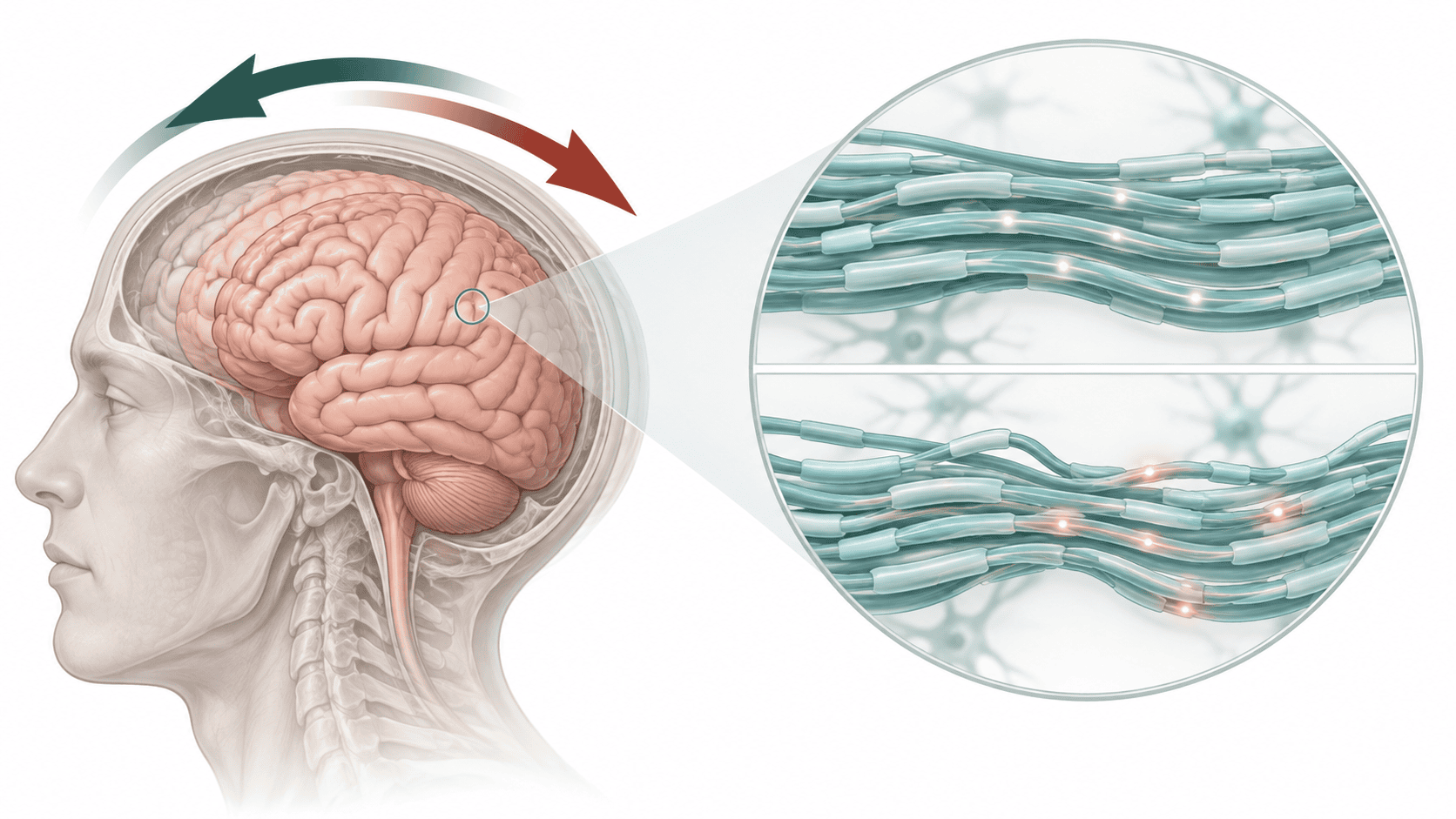
How sudden motion can strain nerve fibers
The brain is soft tissue suspended inside the skull. During a collision, fall, or other sudden movement, the skull may stop or change direction before the brain does. Different areas of brain tissue can move at different speeds.
Those forces may stretch, twist, or disrupt axons, the long nerve fibers that carry signals between brain cells. Even subtle interference with those communication pathways can affect thinking, memory, balance, mood, and sleep. A direct blow to the head is not required; rapid acceleration, deceleration, or rotation can transmit force to the brain even when the head does not strike an object. The mechanism and extent of any particular injury require medical evaluation; not every concussion involves the same pattern or severity of axonal injury.
Physical symptoms
- Headaches or pressure in the head
- Dizziness or balance problems
- Nausea, fatigue, or low energy
- Sensitivity to light or noise
- Blurred vision or other vision changes
- Changes in smell or taste
Thinking and memory
- Difficulty concentrating or following a conversation
- Short- or long-term memory problems
- Feeling slowed down, foggy, or overwhelmed
- Trouble organizing, planning, or completing familiar tasks
- Reduced mental endurance
Mood and behavior
- Irritability or becoming angry more easily
- Anxiety, sadness, or emotional changes
- Withdrawal from family or ordinary activities
- Personality or impulse-control changes
Sleep
- Trouble falling or staying asleep
- Sleeping more or less than usual
- Waking without feeling rested
- Daytime fatigue that worsens other symptoms
A brain injury can alter the whole pattern of a life
The medical symptoms are only part of the story. Cognitive, physical, and emotional changes can interact and affect the roles, relationships, independence, and sense of identity that gave a person’s life its shape before the injury.
Why brain injuries are often missed
The emergency room has an urgent job
Emergency imaging is often directed toward identifying bleeding, fracture, swelling, and other conditions requiring immediate intervention. The absence of those findings does not necessarily resolve whether a concussion or persistent post-concussive condition exists.
Symptoms can look unrelated
Sleep disruption, irritability, headaches, memory trouble, fatigue, anxiety, and reduced concentration may be treated as separate complaints unless someone reconstructs how the person functioned before and after the trauma.
The person may look “fine”
Someone may speak normally, return to work, or continue caring for a family while using far more effort and compensatory strategies than before. Visible independence does not always mean complete neurological recovery.
The record may be fragmented
Evidence may be spread across ambulance, hospital, primary-care, neurological, psychological, rehabilitation, imaging, employment, and family sources. Meaningful evaluation often depends on putting the entire timeline together.
Normal imaging does not end the inquiry
CT and MRI are important medical tools, but a concussion may be diagnosed from the history, symptoms, and clinical examination even when conventional imaging does not reveal an acute structural injury.
The right question is not whether one test “proves” every aspect of the injury. The question is whether the medical history, contemporaneous records, neurological examinations, neuropsychological testing when appropriate, imaging, functional changes, work history, and longitudinal course tell a consistent story.
The diagnostic toolbox keeps evolving
A lawyer handling a TBI case must understand the changing tools clinicians may use, what each can contribute, and where the science remains unsettled. Otherwise, an important injury may be overlooked or a test may be given more weight than it can reliably carry.
Conventional CT and MRI, clinical examinations, neuropsychological testing, vestibular and vision assessment, rehabilitation findings, and emerging imaging techniques answer different questions. Advanced techniques such as diffusion tensor imaging may be considered in selected clinical or research settings, but they are not universal diagnostic shortcuts. Their medical use and legal foundation must be evaluated case by case with qualified professionals.
What if there was a prior concussion or brain injury?
Returning to work or living independently after an earlier TBI does not always establish complete neurological recovery.
People can learn to compensate for residual problems involving attention, memory, processing speed, executive function, headaches, fatigue, or cognitive endurance. Routines, experience, organizational systems, additional effort, and cognitive reserve may allow successful function. A later injury can disrupt that adaptation and make previously manageable deficits substantially more disabling.
That does not mean every later concussion worsens an earlier injury. The analysis must remain individualized. It should begin with the person’s actual pre-accident baseline, the changes after the new trauma, the persistence of those changes, and how well the medical and functional evidence fits together.
How Zivotov Law develops a brain-injury case
A brain-injury case cannot be reduced to one scan, one office visit, or one diagnostic label. We look beyond the obvious and build the record around the person’s real life.
Reconstruct the baseline
We examine education, work, family responsibilities, prior symptoms, routines, and actual functioning before the incident.
Build the timeline
We organize the early signs, delayed symptoms, treatment history, testing, and changes observed by the people who know the client best.
Connect medicine and proof
We work to preserve the records, witnesses, expert analysis, and accident evidence needed to explain both causation and the injury’s human consequences.
Experience recognizing injuries others overlooked
Some of our most important results began with a willingness to question assumptions and examine what had been missed.
Zivotov Law and co-counsel obtained a settlement for heavyweight boxer Magomed Abdusalamov after delayed diagnosis and treatment of a developing brain bleed left him with catastrophic neurological injuries. Contemporary reporting described it as what was believed to be the largest personal-injury settlement New York State had paid at the time.
A jury verdict in a case involving traumatic brain injury and fracture. The result reflected the work required to explain serious injuries and their consequences through evidence rather than labels.
A pretrial construction-accident settlement in a difficult-liability case. When the client first consulted Zivotov Law approximately two years after the accident, Boris Zivotov immediately recognized signs of traumatic brain injury that prior medical and legal professionals had overlooked and directed him toward appropriate evaluation.
A client came to Zivotov Law after her prior lawyer recommended a $12,000 settlement. Her medical records and deposition testimony contained repeated warning signs of TBI, yet she had never been referred for evaluation. With no prior familiarity with brain injury, she described her new attention and concentration problems by saying she felt as though she had suddenly developed ADHD. Zivotov Law recognized the pattern, directed her to appropriate diagnosis, and quickly obtained the full $100,000 of available insurance. Although the coverage was limited, recovering the full policy provided meaningful compensation for a struggling single mother.
Prior results do not guarantee a similar outcome. Every case depends on its own facts, injuries, available insurance, evidence, and law.
Tell us what changed after the accident
If you or a family member has experienced headaches, sleep disturbance, irritability, memory problems, cognitive difficulty, dizziness, or other changes after an accident, we can listen, review the available information, and help identify the legal next steps.
Do not delay while trying to identify every responsible person, company, agency, or insurer. The consultation is free. Even a fall on black ice in a parking lot may involve property owned by a municipality but leased or controlled by a private entity. Some claims involving a municipality or public authority may require a notice of claim within as little as 90 days. Do not take chances: early legal involvement helps identify the responsible parties and preserve video, scene evidence, records, and witness accounts before they change or disappear.
Trusted medical information
For general medical guidance, see the CDC’s symptoms and danger-sign information, the National Institute of Neurological Disorders and Stroke overview of TBI, and the American College of Radiology’s Head Trauma Appropriateness Criteria.
For contemporaneous reporting concerning the $22 million Abdusalamov settlement, see ESPN’s September 2017 report.
This page provides general educational information, not medical advice or a guarantee of legal representation. Seek qualified medical care for diagnosis and treatment. Viewing this page or contacting the firm does not create an attorney-client relationship.